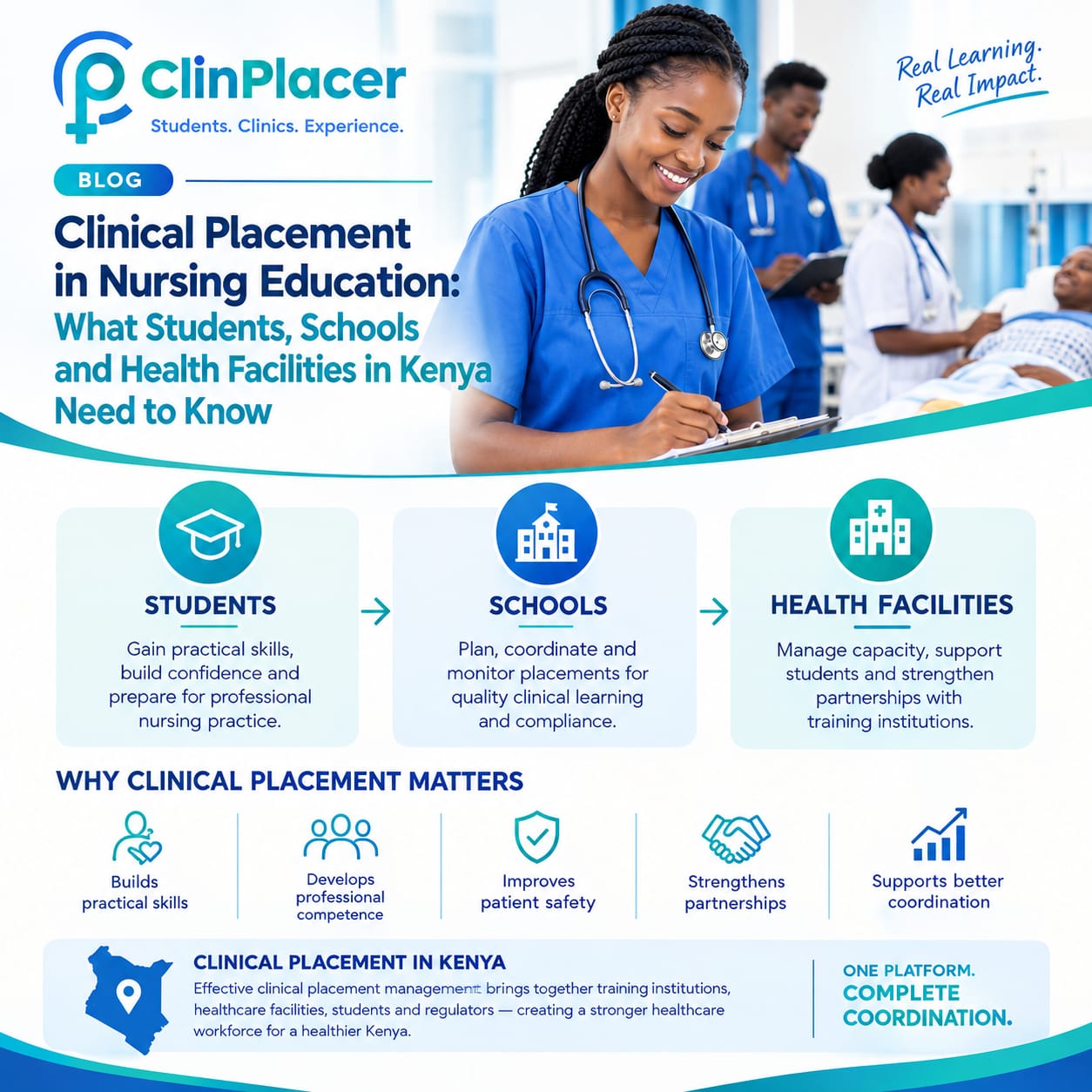
Nursing education is more than lectures, textbooks, assignments and examinations. While classroom learning provides students with the theoretical foundation of nursing, clinical education gives them the opportunity to apply that knowledge in real healthcare environments.
For nursing students in Kenya, clinical placement is an important part of this journey. It provides an opportunity to interact with patients, work alongside healthcare professionals, develop practical skills and understand what it means to provide safe and professional care.
But clinical placement is more than simply sending a student to a hospital.
It requires planning, coordination, communication, appropriate clinical learning environments and collaboration between training institutions, healthcare facilities and students.
This is where effective clinical placement management becomes important.
What Is Clinical Placement?
Clinical placement is the period during which a nursing student undertakes supervised practical learning within an approved or appropriate healthcare environment.
Depending on the student's programme and learning objectives, clinical learning may take place in different departments and healthcare settings. Students may gain experience in areas such as medical-surgical nursing, maternal and newborn health, pediatrics, mental health, community health and other areas relevant to their programme.
The purpose is not simply to give students practical experience. Clinical placement allows students to develop and demonstrate competencies while applying the knowledge and skills they have learned during their academic training.
For example, a student may learn about vital signs in a classroom or skills laboratory. During clinical placement, that student has the opportunity to take vital signs from an actual patient, communicate appropriately, maintain patient privacy, document findings and report relevant information to the supervising healthcare professional.
That transition from theory to practice is one of the most important parts of nursing education.
Why Is Clinical Placement Important?
A nursing student cannot develop professional competence through classroom learning alone.
Clinical placement helps students develop practical and professional abilities such as:
- Patient assessment
- Communication with patients and families
- Infection prevention and control
- Documentation
- Teamwork
- Time management
- Professional conduct
- Clinical decision-making
- Patient safety
- Practical nursing skills
Students also learn how healthcare teams' function in real environments.
They interact with registered nurses, clinical instructors, doctors, other healthcare professionals, patients and families. These experiences help students understand the responsibilities and expectations associated with professional nursing practice.
Clinical placement can also build confidence.
The first experience in a real healthcare environment can be challenging. Students may feel nervous about interacting with patients, adapting to different departments, following clinical schedules or meeting professional expectations.
With appropriate supervision and repeated exposure to clinical environments, these experiences become valuable opportunities for professional growth.
Clinical Placement in Kenya
Clinical education in Kenya operates within a regulated nursing and midwifery education environment.
The Nursing Council of Kenya (NCK) plays an important role in regulating nursing and midwifery education and professional practice. Training institutions and healthcare facilities therefore have responsibilities to ensure that clinical learning is appropriately planned and conducted within the applicable regulatory and institutional requirements.
This makes clinical placement coordination an important responsibility for nursing training institutions.
A school may have hundreds of students who need to undertake different clinical rotations at different times, while healthcare facilities may receive placement requests from several training institutions.
This creates a coordination challenge.
The Role of Training Institutions
Nursing training institutions are responsible for ensuring that their students receive appropriate opportunities for clinical learning as part of their education.
Clinical placement coordination can involve:
Identifying suitable clinical learning environments
Planning student rotations
Coordinating with healthcare facilities
Allocating students to clinical areas
Managing placement dates
Communicating requirements to students
Monitoring student placements
Maintaining placement records
Coordinating clinical supervision
Preparing relevant documentation
Where several institutions use the same healthcare facilities, coordination becomes even more important.
Without proper planning, institutions can encounter problems such as overlapping rotations, excessive student numbers in a department, last-minute changes and communication gaps.
The Role of Healthcare Facilities
Healthcare facilities are an important part of clinical education because they provide the environments in which students gain practical experience.
A facility may have to coordinate students from multiple training institutions while simultaneously managing its normal healthcare operations.
This means the facility needs visibility of:
Which institution is sending students
How many students are expected
When they are arriving
Which departments they require
How long their rotation will last
What learning activities are expected
Relevant agreements and documentation
Who is responsible for coordination
Clinical capacity is not unlimited.
A department may only be able to accommodate a certain number of students at a particular time without negatively affecting the clinical learning environment or normal service delivery.
Effective placement planning therefore benefits both the training institution and the healthcare facility.
The Importance of Rotation Planning
One of the important aspects of clinical placement management is rotation planning.
Where multiple institutions share clinical resources, coordinated planning can help reduce conflicts and improve the use of available clinical learning opportunities.
A well-organized rotation plan should provide clarity about:
Who is going where,
when they are going,
which department they will use, and
how many students will be present.
This becomes increasingly difficult when placement information is managed across spreadsheets, emails, phone calls, paper documents and separate communication channels.
A digital system can help bring this information into a more structured environment.
Common Clinical Placement Challenges
Clinical placement can become difficult when coordination processes are largely manual.
Training institutions and healthcare facilities may experience challenges such as:
1. Limited Clinical Capacity
Healthcare facilities have finite capacity. Several institutions may request placement opportunities at the same time, creating competition for available clinical areas.
2. Placement Conflicts
Two or more groups may be scheduled for the same department during the same period.
3. Communication Gaps
Changes to dates, student numbers or clinical areas can be difficult to communicate when information is distributed across multiple channels.
4. Manual Records
Spreadsheets and paper records can become difficult to maintain as student numbers and placement locations increase.
5. Difficulty Monitoring Placements
Institutions may need to track large numbers of students across different facilities, departments and rotation periods.
6. Last-Minute Changes
Changes in facility capacity, academic schedules or clinical requirements can require placement plans to be adjusted quickly.
These challenges are not necessarily caused by a lack of commitment from schools or healthcare facilities. Often, they are a result of managing increasingly complex placement processes with tools that were not designed specifically for clinical placement coordination.
Where Technology Can Help
Digital clinical placement management can bring greater structure and visibility to the placement process.
Instead of relying entirely on disconnected spreadsheets, emails, phone calls and paper records, institutions can use a centralized system to manage relevant placement information.
A digital platform can help schools and facilities coordinate:
Student placements
Rotation schedules
Clinical departments
Placement capacity
Placement requests
Approvals
Communication
Documentation
Monitoring
Reports
The goal is not to replace the professional or regulatory responsibilities of schools, facilities or regulators.
The goal is to make coordination more organized, transparent and manageable.
How ClinPlacer Supports Clinical Placement Management
ClinPlacer is a digital clinical placement management platform designed to support the coordination of clinical placements between training institutions and healthcare facilities.
For training institutions, ClinPlacer provides a structured environment for planning and managing student placements, coordinating rotation periods and maintaining placement information.
For healthcare facilities, the platform provides greater visibility into placement requests, student numbers, departments and scheduled rotations.
For students, ClinPlacer can provide a clearer view of relevant placement information and requirements, helping them understand where and when they are expected to undertake their clinical learning.
By bringing relevant stakeholders and placement information into one digital environment, ClinPlacer helps reduce the complexity associated with coordinating clinical placements.
Clinical Placement Is More Than an Academic Requirement
It is easy to think of clinical placement simply as another requirement that a nursing student must complete before graduation.
In reality, it is one of the most important stages of professional development.
Every clinical shift provides an opportunity for students to connect what they learned in class with what happens in real healthcare environments.
They learn how to communicate with patients.
They learn how to work within a healthcare team.
They learn how to respond to different situations.
They learn the importance of professional conduct, accountability, documentation and patient safety.
They also learn that nursing is not only about performing clinical procedures. It is about caring for people responsibly, respectfully and professionally.
Preparing for Clinical Placement
Students can make their clinical placement experience more productive by preparing before they report to their assigned facility.
Students should:
Check their placement information regularly.
Understand their reporting dates and clinical area.
Complete required documentation before reporting.
Follow the requirements of their training institution and clinical facility.
Observe professional standards.
Arrive on time.
Maintain appropriate professional appearance.
Respect patients and healthcare workers.
Follow infection prevention and control procedures.
Ask questions when unsure.
Take feedback seriously.
Maintain appropriate clinical records.
Treat every placement as an opportunity to learn.
Being organized is part of being professional.
Building Better Clinical Education Through Better Coordination
Quality nursing education depends on more than what happens inside a classroom.
Students need meaningful clinical learning opportunities. Training institutions need effective placement planning. Healthcare facilities need manageable student numbers and clear communication. Regulators establish standards that help guide the quality and safety of nursing education and professional practice.
These responsibilities are interconnected.
When clinical placement coordination works well, students have clearer expectations, institutions have better visibility of their placements and healthcare facilities can better prepare for incoming learners.
Technology can support this coordination.
ClinPlacer is built around that idea: connecting students, empowering institutions and strengthening healthcare through better clinical placement coordination.
Clinical placement is not simply about where a student goes.
It is about creating an organized environment in which future healthcare professionals can learn, practice, develop confidence and prepare for professional nursing practice.
And when the process supporting that learning is properly coordinated, everyone benefits — the student, the training institution, the healthcare facility and ultimately the patients they will serve.